Muse Image
Agentic image generation and editing that searches the web for real references before it renders.
meta/muse-image-1.0/image-to-image
Examples
representative generations · starting points to seed the playground
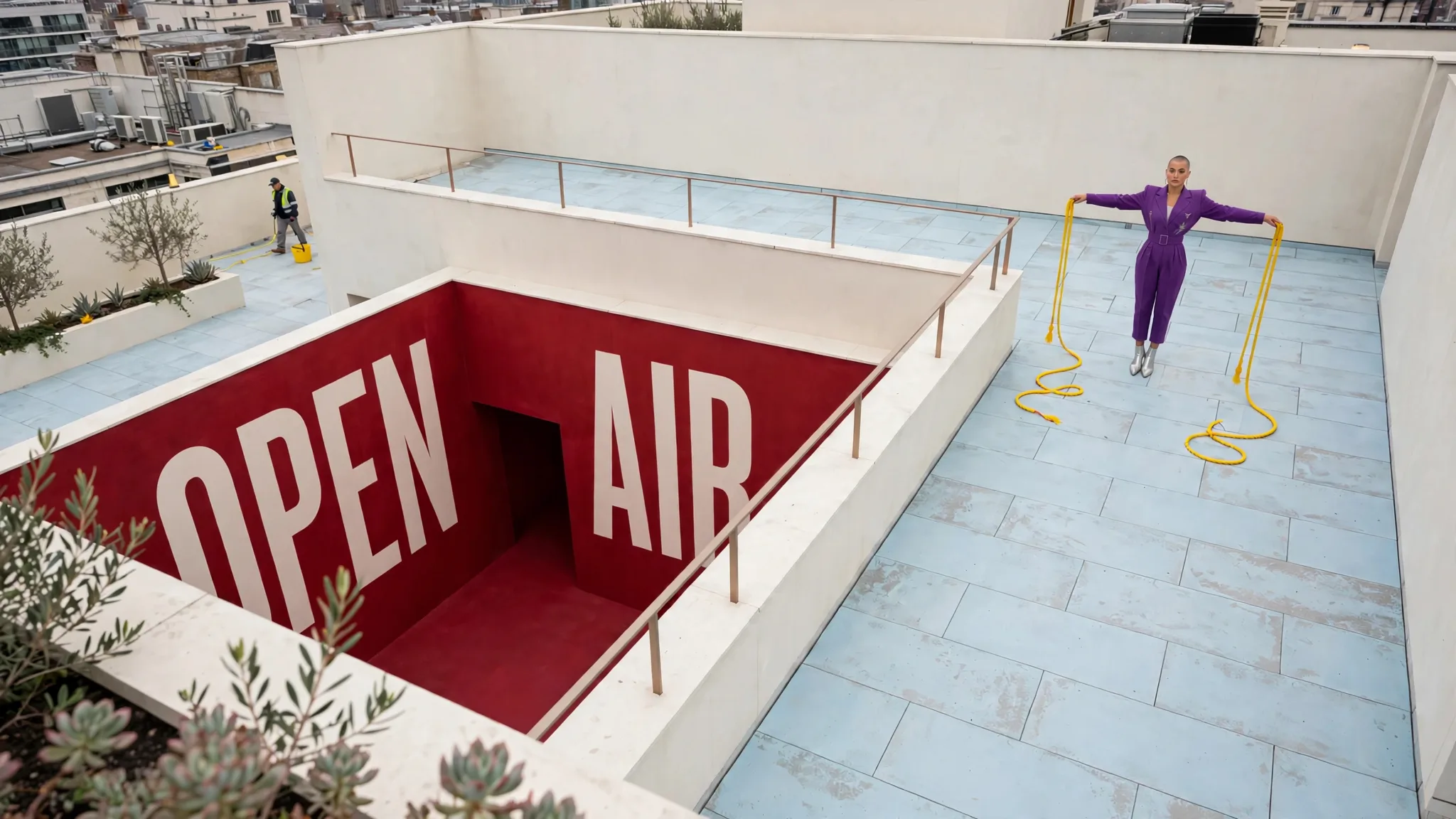
REAL ENVIRONMENT 2/7. Translate the overhead geometric idea into a real modern rooftop terrace seen from a high oblique angle. Move the shaved-head model to the upper-right third rather than center. Pale powder-blue paving leads toward a deep vivid-red architectural inset; ivory and crimson are the main complementary pair, with lemon used sparingly. Preserve the outstretched pose and cords as the single believable surreal twist. Add one very small distant maintenance worker on a lower roof. Soft overcast light. Add exactly the title "OPEN AIR" once on the large red wall area, comfortably inside the frame and away from the roofline. "open" on one side, "Air" on the other side. Use a large refined uppercase editorial sans-serif in white, with crisp natural typesetting, clean kerning, and correct spelling. The title should feel integrated into a contemporary fashion editorial layout while remaining clearly readable. No other text.
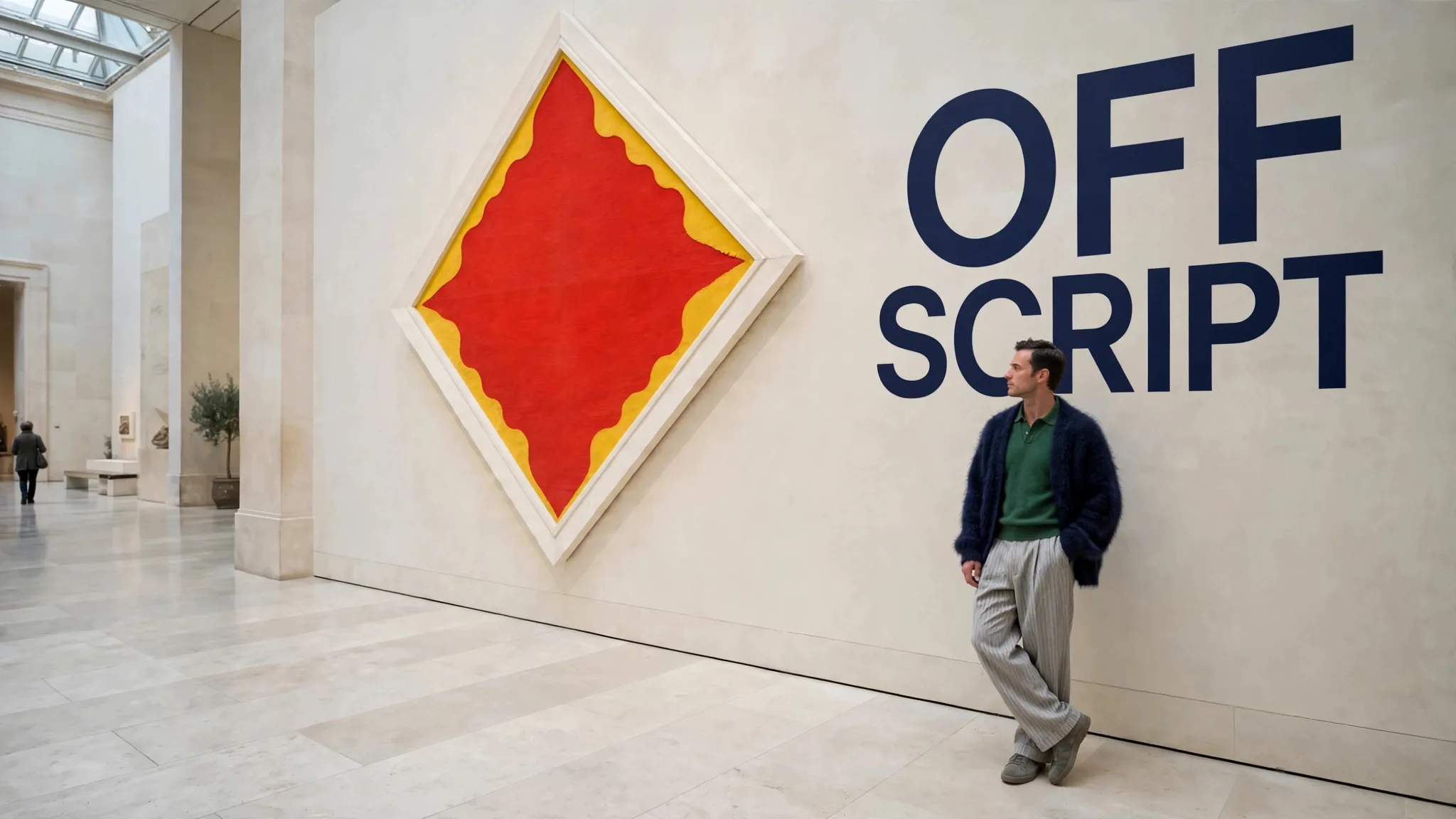
Edit the supplied photograph of a museum gallery. Landscape 16:9. Make two changes — the wall lettering and the standing figure. KEEP UNCHANGED: the same viewpoint, framing and perspective; the same diamond artwork with its red centre, yellow scalloped border and pale timber frame at the same size and position; the same cream limestone walls, The standing figure at the right keeps the same position leaning against the wall, the same pose with one hand in a pocket, and the same head turned in profile looking left toward the artwork. CHANGE 1 — THE LETTERING. The wall carries the words 'OFF SCRIPT' and nothing else. Set them in a bold neo-grotesque SANS SERIF: heavy strokes of uniform width with no thick-to-thin modulation, terminals cut flat and square, stems straight with no flaring, feet or serifs of any kind. It must NOT read as a thin high-contrast engraved museum serif — no Didot, Bodoni or Trajan look. Deep navy matte exhibition vinyl, set on two lines with 'OFF' above 'SCRIPT', tight tracking. The lettering is MONUMENTAL — it dominates the wall and is the co-equal graphic element with the artwork. Each line runs the full width of the wall plane to the right of the artwork, and the capitals are so tall that the two stacked lines fill the wall from close to the ceiling down past the standing figure's head, each capital roughly a quarter of the picture height. The type is far larger than any normal exhibition title. It continues behind the standing figure and reappears on the far side of them, so they read as standing in front of it. The lettering lies flat on the wall and follows the wall's perspective, foreshortening and converging with the plane. Spelling stays exactly OFF SCRIPT. No other text, label, signage, logo or watermark anywhere. CHANGE 2 — change the subject to a man. Restyle the standing figure completely: remove the jacket, the red top, the pale trousers and the brown leather loafers. Dress them instead in relaxed, softly tailored clothing, everything cut LOOSE with generous drape, nothing preppy or corporate: - a fuzzy brushed navy cardigan, a chunky soft mohair knit with a visible hairy halo of fibres, worn open, oversized and slouchy; - underneath, a rich true GREEN knitted cotton polo, collar open, relaxed fit; - loose PINSTRIPE trousers, wide and softly draping with a full break, light grey with fine even vertical stripes, generously cut, never skinny or cropped; - simple unfussy shoes, not polished brown leather. The green and navy read as complementary colours against the artwork's red and yellow. Keep fabrics real and tactile — brushed knit fibre, soft cotton pique, woollen suiting weave.
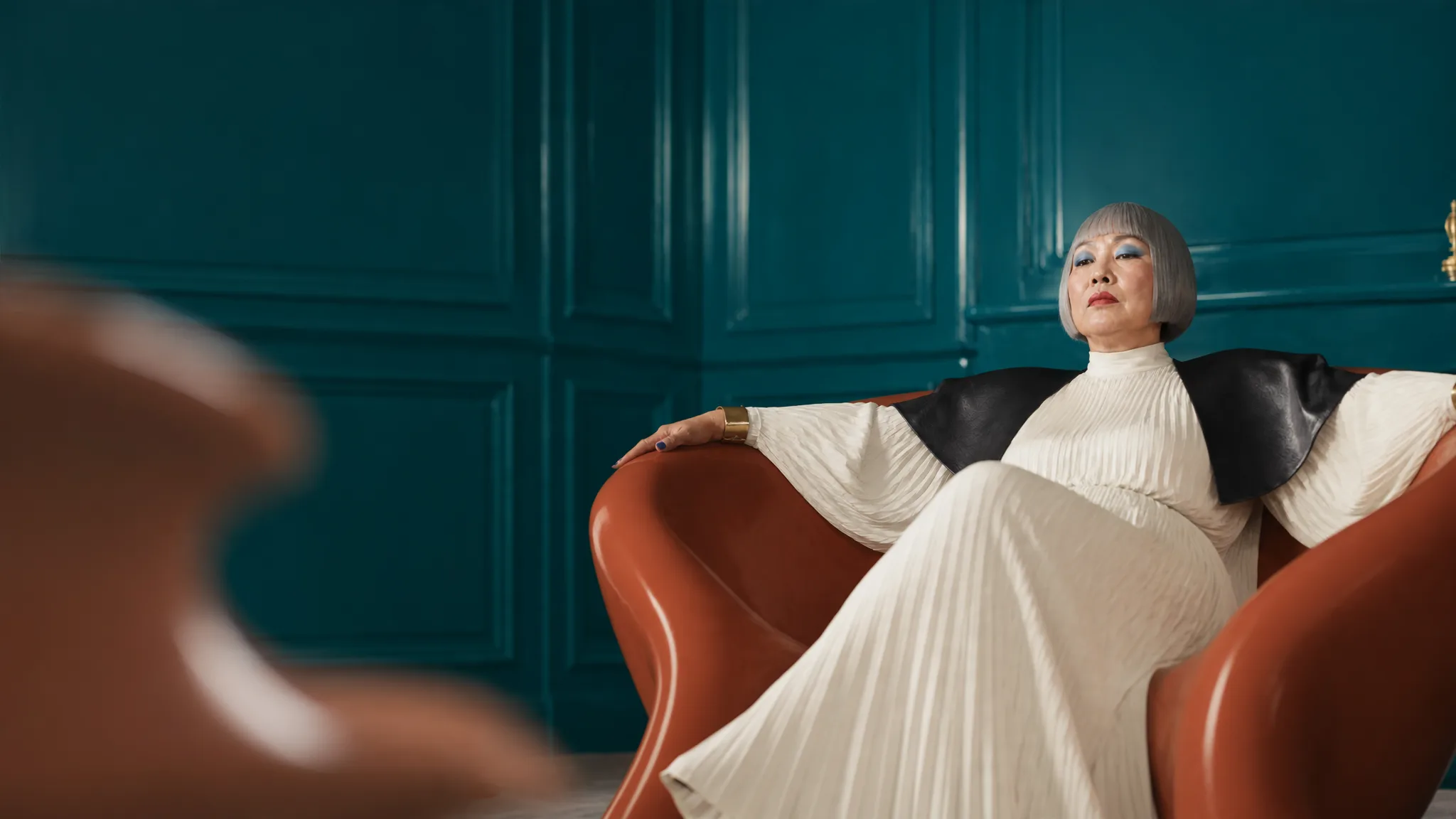
Edit the supplied image into a refined editorial photograph while retaining its recognizable subject, core visual idea, and key wardrobe silhouette. Follow these rules strictly. COLOR: soft but vibrant, never muted, washed out, oversaturated, or color-cast. Use true whites and natural skin. Build one clear complementary pairing per image: a lighter tone against a deeper saturated tone, usually warm against cool. Allow one bold leading color. Keep contrast low to moderate; never use teal-and-orange grading or a stylized tint. LIGHTING: soft, diffused, even, dimensional neutral light, as from a very large close source, overcast sky, or open shade. No hard sun, bare flash, sharp-edged shadow, colored mood light, or flat illumination. Fill shadows while retaining soft dimensional shadow and detail in skin, fabric, and surfaces. Highlights roll off gently. COMPOSITION: clean, structured, readable and asymmetrical. Place the main subject clearly off-center on a rule-of-thirds point; never dead-center. Create distinct foreground, subject, and background layers. Use real leading lines and intentional negative space. Separate subject from background through complementary color, neutral light, and/or gentle depth of field. A small distant secondary figure, animal, or object may be added only when it strengthens depth and scale. For groups, break the level line with subjects at clearly different heights. No clutter, fisheye, or distortion. TONALITY: playful, imaginative, quietly witty, grounded and photographed straight. Use at most one believable surreal twist that creates tension between natural and unnatural. Never fantastical, silly, cutesy, twee, or cheesy stock emotion. Elevated real clothing with a sophisticated unexpected styling twist. GRADE AND TEXTURE: natural restrained grade; low-to-moderate contrast; open detailed shadows; creamy finish; softly rolled highlights; slight warmth; whites remain white; natural skin; light natural film grain only. No HDR, heavy clarity, sharpening, crushed blacks, or digital slickness. WARDROBE: balance 50% statement couture and 50% elevated real-world styling. Preserve the source silhouette where
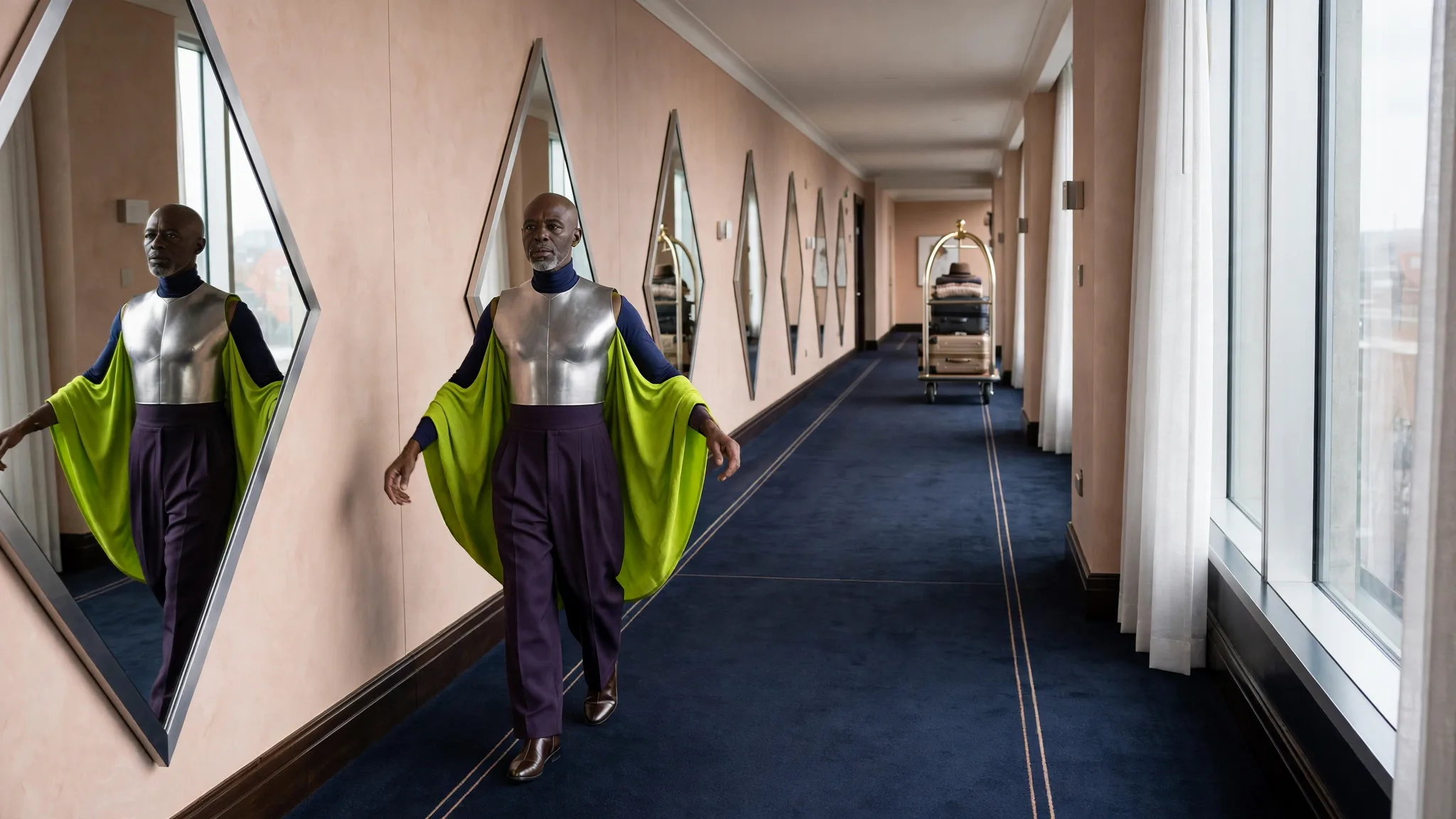
REAL ENVIRONMENT 5/7. Transform the mirrored corridor into a believable contemporary hotel passage under soft window light. Place the older male lead on the left third walking toward camera; mirrors and floor seams form real leading lines toward him. Keep two or three smaller reflections farther back rather than a perfectly repeated army. Pale peach walls against ink navy, chartreuse as a controlled wardrobe accent. One tiny luggage cart at the far end adds scale. Soft dimensional shadows, no perfect symmetry.